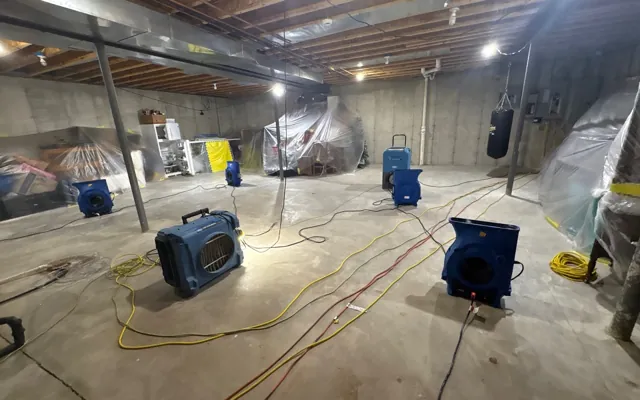
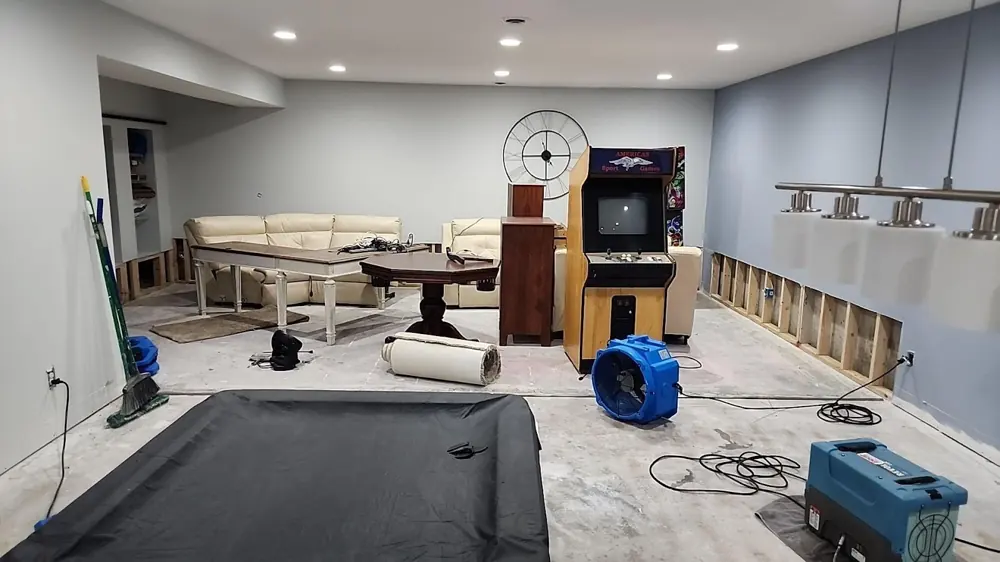
True basements are essentially nonexistent in Lafayette's high water table, but the lowest level of a home, a slab first floor, sunken room, or garage, floods just the same. Local crews respond 24/7 to pump out, extract, and dry the lowest level fast.

Submersible pumps clear any deep water from a garage or sunken room, and truck-mounted extractors pull the rest off floors and out of carpet.
Wet carpet and pad, saturated lower drywall, and damaged insulation are removed so the slab and framing can be reached and dried.
Air movers and dehumidifiers dry the slab, wall base, and framing, with moisture readings logged daily until every reading returns to a safe level.
Surfaces are treated with antimicrobial where needed, then flooring, drywall, and baseboards are restored so the space looks finished again.

While help is on the way, these first steps, done only where it is safe, limit the damage and protect the insurance claim.
Shut the supply off at the source, or close the home's main valve if the source is not obvious. Stopping the flow limits the damage more than anything else.
Switch off electricity to the affected area, but only if the breaker can be reached without standing in or touching the water.
Get a crew dispatched right away. The sooner extraction and drying begin, the more flooring, drywall, and belongings can be saved.
Take photos and a short video of the water and the affected rooms before anything is moved, so the insurance claim starts strong.
Cleaning up a flooded lowest level in Lafayette usually runs $2,000 to $7,500, depending on how much water came in, how long it sat, and how much finished space, carpet, and drywall was affected. Because homes here are slab-on-grade rather than below grade, the water spreads wide but does not pool as deep as a true basement. Sudden interior losses are often covered by homeowner policies, while rising floodwater usually needs a flood policy; the loss is documented for your adjuster.
Crews reach Lafayette and Acadiana fast, from Downtown, the Saint Streets, and Freetown-Port Rico to Youngsville, Broussard, Carencro, Scott, and Breaux Bridge. See the full list on the areas served across Lafayette page.
See all areas servedEvery loss is photographed, measured, and logged from the first visit, so the paperwork holds up with your insurance carrier.
Technicians follow recognized IICRC drying standards and prove the work with daily moisture readings, not guesswork.
Emergency dispatch any hour of the day or night, with a real crew on the way, not a callback in the morning.
A real crew dispatched any hour, not a callback in the morning.
Trained technicians following recognized IICRC drying standards.
Truck-mounted, portable, and submersible for any size loss.
The loss is documented and billed to the carrier directly.
Very few. The high water table makes below-grade construction impractical, so homes here are slab-on-grade. When people say basement flooding, they usually mean a flooded slab first floor, sunken room, or garage, which crews handle the same way.
In Lafayette's humidity, mold can begin within 24 to 48 hours if moisture lingers. That is why crews extract and start drying immediately and treat surfaces with antimicrobial before restoring.
Sudden interior losses, like a burst pipe or a failed water heater, are usually covered by homeowner policies. Rising water from outside typically needs a separate flood policy. The cause is documented to support whichever claim applies.
Most take five to ten days, since concrete holds moisture and releases it slowly. Crews run equipment continuously and check readings daily, pulling the gear only once the materials test dry.
Keep gutters and yard drains clear, extend downspouts away from the slab, and make sure the ground slopes away from the house. If a sump serves a sunken area, add a battery backup and test it before storm season.
Lafayette crews are on call 24 hours a day, local and fast, and can be on the way within the hour.
Call (337) 614-6808