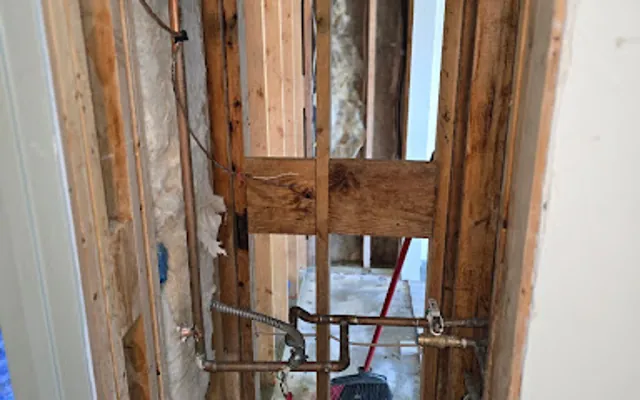
Hard freezes are rare in Lafayette, but a handful of nights each year drop below freezing, and an exposed pipe can still split. When it thaws, local crews respond 24/7 to clean up the water and dry every cavity it reached.

Crews shut the water at the main and isolate the split line so no more water flows once the pipe has thawed.
Standing and absorbed water is pulled from floors, carpet, and cabinet bases before it spreads further through the home.
Wet baseboards and lower drywall are opened as needed so air movers and dehumidifiers can dry the wall cavities and framing the water reached.
Once readings confirm dry, materials are restored, and crews point out the vulnerable pipe run so it can be insulated before the next freeze.

While help is on the way, these first steps, done only where it is safe, limit the damage and protect the insurance claim.
Shut the supply off at the source, or close the home's main valve if the source is not obvious. Stopping the flow limits the damage more than anything else.
Switch off electricity to the affected area, but only if the breaker can be reached without standing in or touching the water.
Get a crew dispatched right away. The sooner extraction and drying begin, the more flooring, drywall, and belongings can be saved.
Take photos and a short video of the water and the affected rooms before anything is moved, so the insurance claim starts strong.
Frozen pipe water damage in Lafayette typically runs $1,000 to $4,000 when it does happen, depending on how long the thawed line ran and how many rooms and wall cavities the water reached. Because hard freezes are infrequent here, this is not a common call, but the damage from a rare freeze can be significant. Sudden freeze-related pipe failures are usually a covered homeowner claim, documented for your adjuster.
Crews reach Lafayette and Acadiana fast, from Downtown, the Saint Streets, and Freetown-Port Rico to Youngsville, Broussard, Carencro, Scott, and Breaux Bridge. See the full list on the areas served across Lafayette page.
See all areas servedEvery loss is photographed, measured, and logged from the first visit, so the paperwork holds up with your insurance carrier.
Technicians follow recognized IICRC drying standards and prove the work with daily moisture readings, not guesswork.
Emergency dispatch any hour of the day or night, with a real crew on the way, not a callback in the morning.
A real crew dispatched any hour, not a callback in the morning.
Trained technicians following recognized IICRC drying standards.
Truck-mounted, portable, and submersible for any size loss.
The loss is documented and billed to the carrier directly.
Rarely, but yes. A few nights most winters drop below freezing, and an occasional hard freeze can split an exposed or under-insulated pipe. Because homes here are not built for cold, those rare events catch a lot of homeowners off guard.
The ones outside the heated part of the home: lines in an unheated garage, under a raised cottage, at an outdoor spigot, or in an exterior wall with little insulation. Those are the runs worth protecting before a cold snap.
Freezing water expands and cracks the pipe, but the crack does not release much until the ice melts. On the thaw, water pours from the split, often while the family is away or asleep, so the damage can be extensive before it is found.
Sudden freeze-related pipe failures are usually covered by homeowner policies, though some require that reasonable heat was maintained. The cause and damage are documented thoroughly to support the claim.
Insulate exposed pipes in the garage, exterior walls, and under a raised home, cover outdoor spigots, let a faucet drip on the coldest nights, and keep the heat on. A little prep goes a long way on the rare freeze night.
Lafayette crews are on call 24 hours a day, local and fast, and can be on the way within the hour.
Call (337) 614-6808